The Most Underrated NDIS Services That Improve Everyday Life
The Scene
Families often open an NDIS plan, scan the primary budget items, and immediately book the big, obvious things—like regular physiotherapy, occupational therapy, or standard personal care.
Months go by, and while those major appointments are helpful, the day-to-day routine at home still feels a bit disjointed. Meanwhile, thousands of dollars in flexible funding sit quietly unspent because nobody explained what else the plan could actually cover.
You think, “We have the main therapies sorted, so why do everyday tasks still feel so exhausting?”
Take a breath. Sometimes, the smallest, most overlooked supports make the biggest difference to daily happiness.
Welcome to 2026. Maximizing an NDIS plan isn’t just about attending clinical appointments; it is about smoothing out the friction of everyday life.
Here is a plain-English look at the most underrated NDIS support options in Victoria today, and practical next steps to help families unlock the hidden value in their plans, subject to individual circumstances.
1. Guided Public Transport & Travel Mentoring
Many families assume NDIS transport funding is strictly a taxi allowance to get from point A to point B.
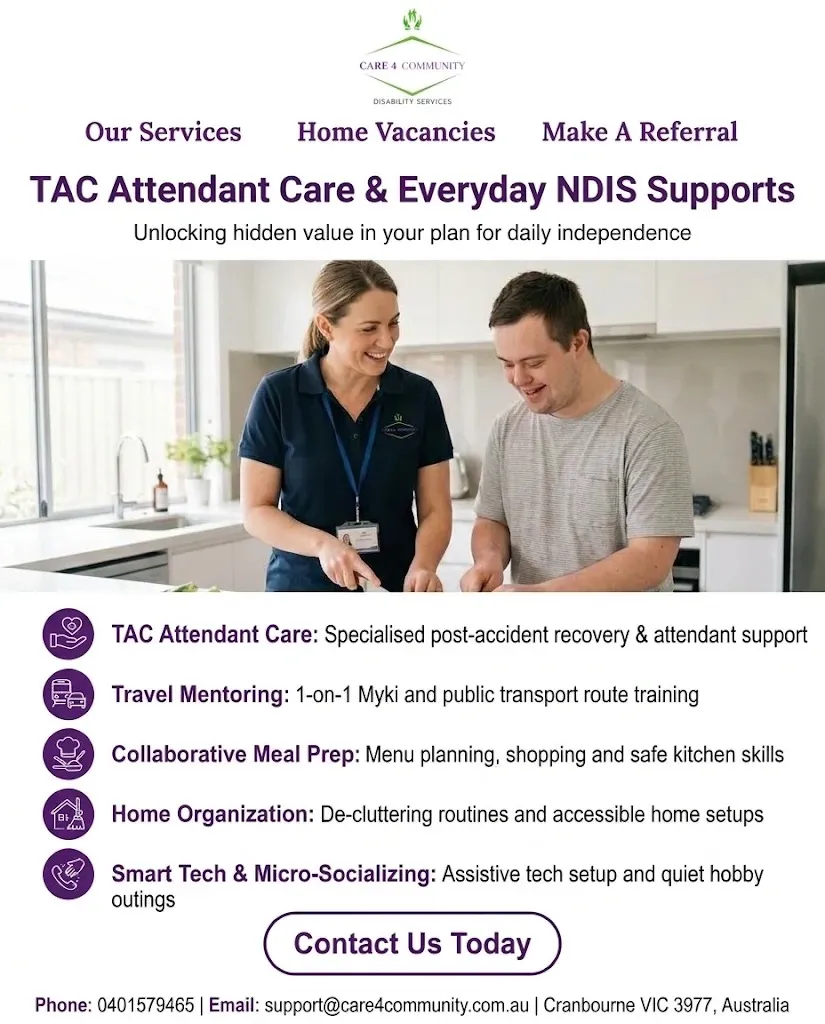
The 2026 Reality: Relying solely on rideshares or family drivers can accidentally limit long-term freedom. One of the most underrated supports available is 1-on-1 travel mentoring. Instead of just driving a participant around Cranbourne or Frankston, a dedicated support worker walks beside them to teach timetable reading, Myki card top-ups, and safe route navigation. Mastering the local bus or train network unlocks massive everyday confidence.
2. Collaborative Meal Prep & Kitchen Skills
When people hear “assistance with daily living,” they often picture a carer coming in to quickly cook a batch of meals while the participant sits in the living room.
The 2026 Reality: Turning mealtime into an interactive, skill-building session is a game-changer. Depending on plan details, support workers can focus on collaborative menu planning, safe knife skills, and navigating local grocery aisles together. Learning to prepare even two simple meals a week transforms a daily chore into a proud ritual of self-reliance.
3. Home Organization & De-Cluttering Routines
Standard domestic cleaning—like vacuuming and mopping—is common, but systemic home organization is frequently overlooked.
The 2026 Reality: A chaotic environment often triggers sensory overload and daily stress, as well as physical trip hazards. Utilizing household task funding to establish clear, accessible organization systems—such as labeled pantry shelves, streamlined wardrobe layouts, and clear walkways—makes maintaining the home independently much easier between support shifts.
4. Low-Cost Assistive Tech & Smart Home Setup
Families often think assistive technology only refers to high-cost items like customized wheelchairs or structural ramps.
The 2026 Reality: Where applicable, the Core consumables budget can often be used for simple, low-cost everyday aids that dramatically reduce daily frustration. Furthermore, having a support worker help set up voice-activated reminders, tablet visual schedules, or ergonomic kitchen tools can bridge the gap between needing constant prompting and managing a morning routine smoothly.
5. Hobby-Based Micro-Socializing
Large group day programs aren’t for everyone, and many participants avoid social funding altogether because they dislike noisy, crowded venues.
The 2026 Reality: Community participation doesn’t have to mean joining a big crowd. An underrated way to use social support is micro-socializing around quiet, specific interests—like visiting a local nursery in South East Melbourne, attending a quiet library workshop, or walking a dog at a peaceful park. It builds genuine community connection without the sensory overwhelm.
The Verdict
The flashiest line items in an NDIS plan aren’t always the ones that bring the most daily joy. Tapping into practical, lesser-known daily supports turns unused budget into genuine everyday ease.
Our Advice:
- Audit Your Unspent Core Funds: Common things to check include how much flexible Core funding is sitting idle mid-way through your plan cycle.
- Ask About Skill-Building: Families may find it helpful to ask their provider how routine domestic shifts can be tweaked to include gentle life-skills mentoring.
- Tailor the Routine: Don’t settle for a generic checklist. Work with a local care team that helps customize daily hours around the little things that actually reduce household stress.
At Care 4 Community, we love helping families across Cranbourne, Frankston, and South East Melbourne discover the practical support options that brighten everyday life. Our compassionate team looks beyond the standard checklist to deliver personalized, empowering daily care.
Curious about how to make your daily support hours work harder for your family? Contact our friendly intake team for plain-English guidance today.